

Thinking of Relocating? Here’s the Skinny on State Income Taxes
When you are considering a move, it is natural to focus first on housing prices, employment opportunities, climate, schools, and proximity to family. However, taxes can also make a surprising difference in your overall cost of living.
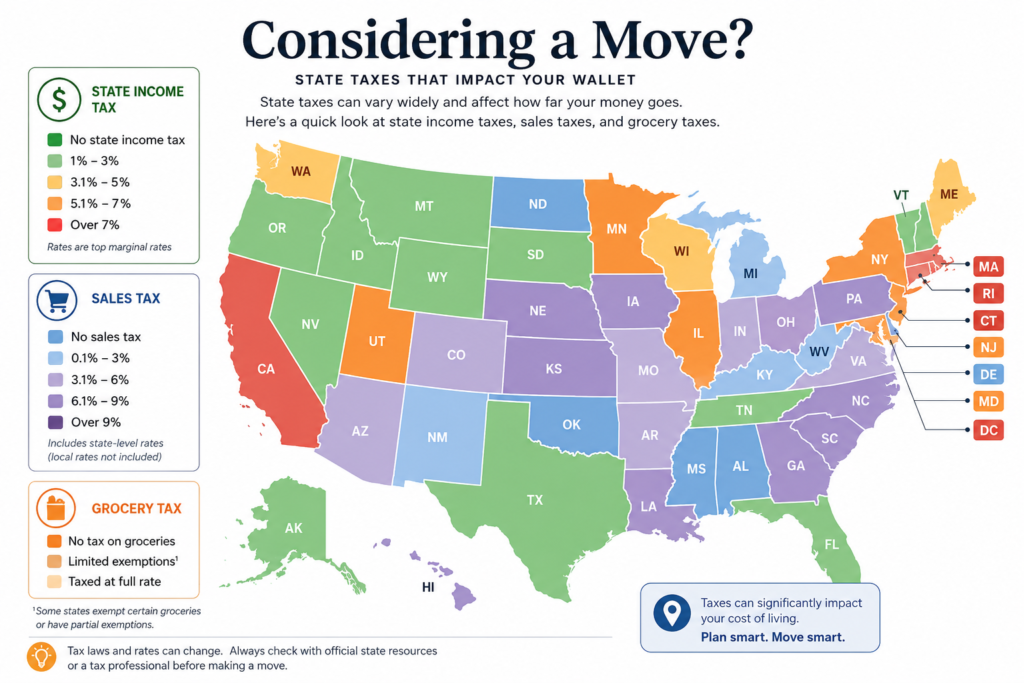
Most states collect some form of income tax, but the rules vary widely from one state to another. Some states do not impose an income tax on wages at all. Others collect income tax but do not charge a statewide sales tax. A smaller number tax groceries, while most states exempt unprepared grocery items.
Understanding these differences can help you make a more informed relocation decision that aligns with your lifestyle, income, and long-term financial goals.
Below is a clear breakdown of how states handle state income taxes, statewide sales taxes, and taxes on groceries as of 2026.
Why State Income Taxes Matter When You Move
State income taxes can affect how much of your earnings you are able to keep after taxes. For someone relocating for a new job, starting a business, entering retirement, or simply looking for a lower cost of living, the tax structure of a potential new home may deserve a closer look.
However, state income tax is only one part of the financial picture.
A state that does not collect income tax may rely more heavily on other sources of revenue. Depending on where you live, those costs may show up through property taxes, sales taxes, or other expenses. This is why it is important to compare the overall cost of living rather than making a relocation decision based on one tax category alone.
Your income sources can also make a difference. A state’s tax structure may affect a wage earner differently than someone who receives significant investment or capital gains income.
States With No Income Tax on Wages as of 2026
Nine states do not impose a state income tax on wages:
- Alaska
- Florida
- Nevada
- South Dakota
- Tennessee
- Texas
- Wyoming
- New Hampshire
- Washington
Washington does not tax wages, but it does levy tax on certain investment and capital gains income.
For people who earn most of their income through wages, living in one of these states can potentially offer significant tax savings. The actual effect will depend on your income sources and your broader financial situation.
It is also important to remember that the absence of state income taxes does not automatically mean that a state is inexpensive to live in. Housing costs, property taxes, insurance, transportation, utilities, and other everyday expenses can still vary considerably.
The most useful question is not simply, “Does this state collect income tax?” Instead, consider asking, “What will my total cost of living look like in this state?”
States With No Statewide Sales Tax
Sales tax is another expense that can influence the cost of everyday purchases. Although individual transactions may not always feel significant, the amount paid in sales tax can add up over the course of a year.
Five states do not impose a statewide sales tax:
- Alaska
- Delaware
- Montana
- New Hampshire
- Oregon
This can make a noticeable difference when purchasing clothing, household goods, electronics, furniture, and other taxable items.
However, the absence of a statewide sales tax does not necessarily mean that every purchase will be free from sales tax. Local municipalities may still impose their own sales taxes in some states.
When comparing potential places to live, look beyond the statewide rate and consider whether the particular city or municipality you are considering has additional local taxes.
States With Neither Income Tax Nor Statewide Sales Tax
Only two states fall into both categories:
- Alaska
- New Hampshire
Neither Alaska nor New Hampshire imposes a state income tax on wages or a statewide sales tax.
At first glance, this combination may appear especially attractive to someone considering relocation. However, these states rely heavily on alternative revenue sources, such as property taxes. Those expenses may affect other areas of your cost of living.
This is a helpful example of why comparing state income taxes alone does not provide a complete picture. A state may charge less in one category while relying more heavily on another.
Before relocating, consider how the complete tax structure may interact with your housing plans, spending habits, and income sources.
States That Tax Groceries
Groceries are a major and unavoidable part of nearly every household budget. For families, retirees, and anyone trying to manage rising living expenses, even a reduced tax on groceries can make a difference over time.
Most states exempt unprepared grocery items from sales tax. However, a handful of states still impose tax on retail groceries:
- Alabama
- Hawaii
- Idaho
- Mississippi
- Oklahoma
- South Dakota
In many cases, groceries are taxed at a reduced rate compared to other goods and services. Even so, grocery taxes are still worth considering when estimating your everyday living expenses.
The effect may be especially noticeable for larger households or anyone with a substantial monthly grocery budget. A relatively small tax applied repeatedly throughout the year can become a meaningful recurring expense.
Comparing More Than State Income Taxes
No single tax category should determine where you live. State income taxes may be important, but they are only one part of your financial life.
When comparing states, consider the complete cost-of-living picture, including:
- State income taxes
- Statewide and local sales taxes
- Taxes on groceries
- Property taxes
- Housing costs
- Insurance expenses
- Transportation costs
- Utilities and other recurring expenses
You may discover that a state with no income tax has higher costs in another area. You may also find that a state with an income tax offers housing, services, or lifestyle benefits that make it a better financial fit for your household.
The best choice depends on your individual priorities and circumstances.
Consider How Your Income Is Earned
The source of your income can also affect how valuable a particular state’s tax structure may be for you.
Someone who earns a regular wage may evaluate a state differently than a person whose finances include investment or capital gains income. Washington, for example, does not tax wages but does levy tax on certain investment and capital gains income.
That distinction illustrates why it is important to understand how a state’s rules relate to your specific income sources instead of relying only on a general list of states without income tax.
Look at the Long-Term Financial Picture
Moving is a major personal and financial decision. The expenses involved extend far beyond the moving truck and the price of a new home.
A state that appears attractive today should also make sense for your longer-term goals. Think about whether you plan to purchase property, change careers, start a business, retire, or live on different income sources in the future.
You do not need to choose a state based entirely on taxes. However, understanding the tax structure can help you avoid surprises and create a more realistic relocation budget.
Remember This About State Income Tax and Relocation
State income taxes can make a meaningful difference when you are deciding where to live, but they should be evaluated alongside sales taxes, grocery taxes, property taxes, and the broader cost of living.
As of 2026, nine states do not impose a state income tax on wages, five states do not impose a statewide sales tax, and only Alaska and New Hampshire fall into both categories. A small group of states also continues to tax retail groceries, although groceries may be taxed at a reduced rate.
Comparing these details can help you approach relocation with greater confidence. Rather than choosing a state based on one appealing tax feature, look at how the complete financial picture fits your income, household budget, and future goals.
Tax laws and individual circumstances can vary, so consider speaking with a qualified tax professional before making a major relocation decision. The Matterhorn Tax Planning team can help you better understand how a potential move may fit into your broader financial and tax-planning strategy.